Garden with Grace

"I hope that while so many people are out smelling the flowers, someone is taking the time to plant some." ~H.Rappaport


Leave a comment

A ‘Deep Purple’ Earworm

While walking outside this morning to discover what is #bloominginmygardennow, a song from my preteen years popped into my head —- ‘Deep Purple.’

“When the deep purple falls, over sleepy garden walls, and the stars begin to twinkle in the night…..”

I listened to that song on a Donny & Marie album over and over again when I was a young girl – back at the time of the hit variety show on television in the 70s. (The original was recorded in 1963 by Nino Tempo and April Stevens – which I didn’t know until I looked up the song online today!) 

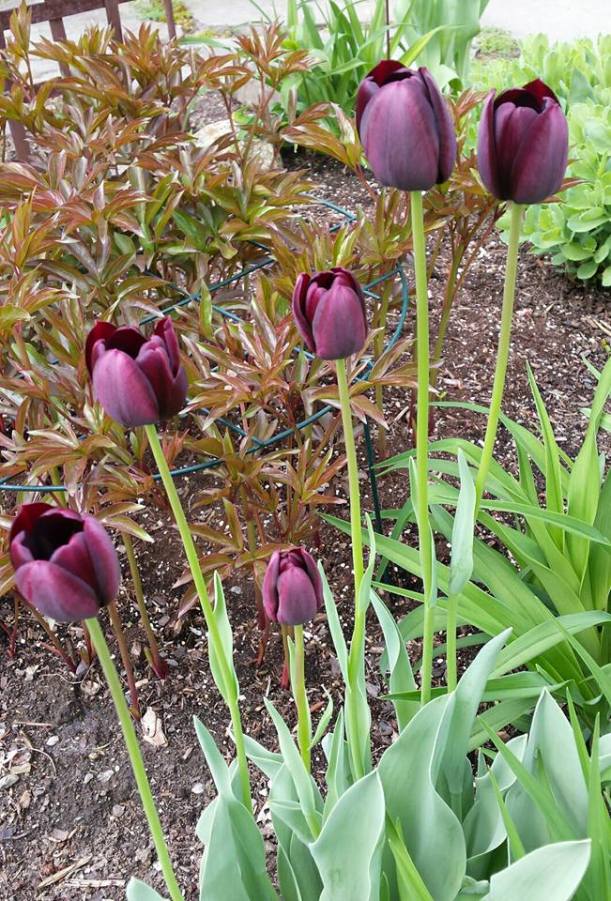
Decades later, ‘Deep Purple’ takes on new significance for me – especially during the first two weeks of May. As the early spring tulips and flowering trees lose their petals, the purple iris emerges – always at the same time as the lilacs. This year, a tulip that hasn’t come up for many years also appeared this week to round out a trifecta of spectacular deep purple blooms during the first 10 days of May.
purpleiris

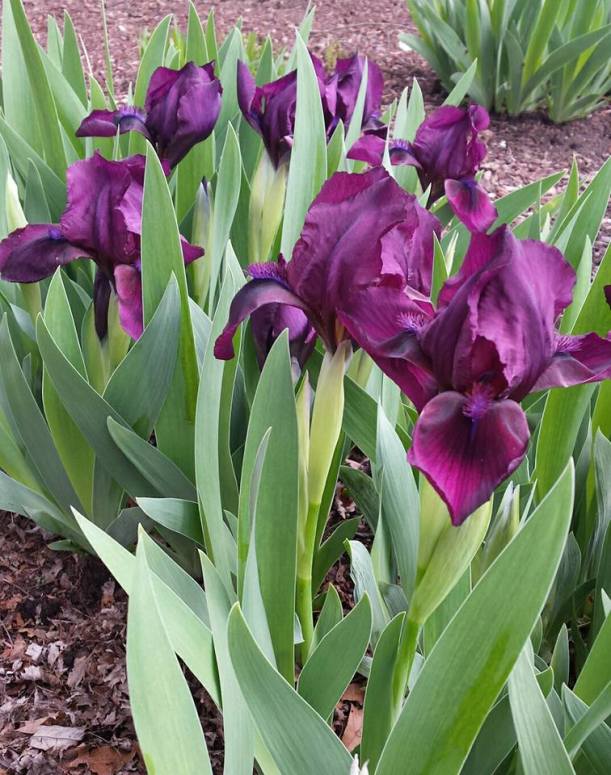
The purple or burgundy iris has been in my garden for 25 years!  My mother brought it home after an early May visit to Uncanoonuc Mt Perennials. Unfortunately, the garden center recently closed after decades of bringing delight to gardeners across New Hampshire. These iris are prolific and have been split every few years to be shared with other gardening friends. (Every year, I hear from at least one other person who is also enjoying these flowers. This week my friends Terri and Ann, both colleagues from Sun Microsystems (who also happen to share the same March Birthday!) reminded me they are also enjoying their annual iris display this week!)

This iris is compact, on a short stem. It’s always the first iris to bloom each spring. It looks especially nice planted with cushion spurge since that is a bright peridot color, blooming at the same time. We lost that companion planting in recent years, so there’s a note for this year’s transplants to make sure the situation is rectified for 2018!
purplelilac

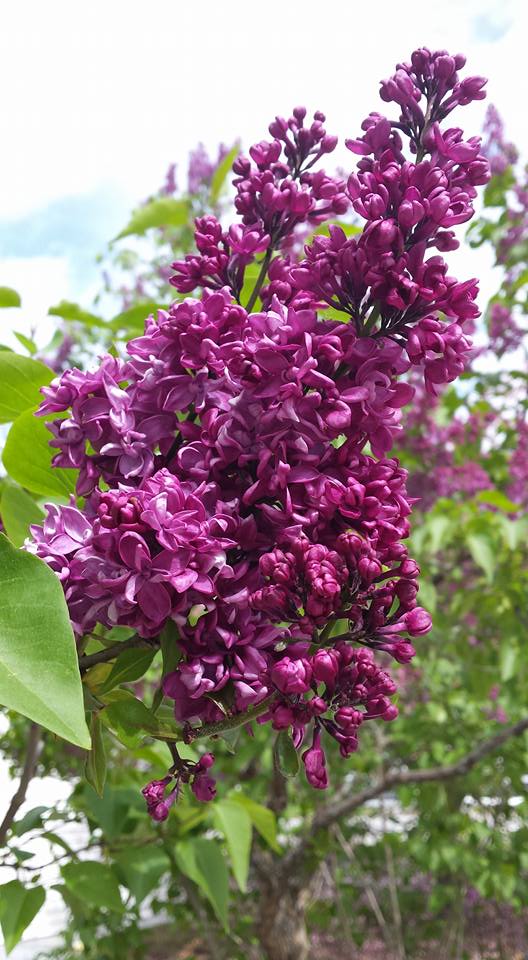
The state flower for New Hampshire is the lilac. The garden has several established lilacs ranging from a light lavender to this deep purple color. We even have a three year old ‘Sensation’ lilac with a patterned mix of white and dark purple petals. Honestly, you find the lilacs in the garden with your nose before ever seeing them with your eyes.

It’s always nice to see our neighbors walk by, slow down, and then stop to smell the flowers hanging over the fence. There’s no better spring experience than deeply inhaling the intoxicating perfume of lilacs.
purpletulips

These tulips were some of the last to emerge this spring. They are in a section of the garden that was originally started by my grandfather.  They were a nice surprise this week. I can’t even remember when they were planted, but I don’t remember seeing them the past few years. They certainly round out the trio of the deep purple flowers that will enhance the garden for the next week or so.

I was hoping that sitting down and writing this story about my garden experience today, the earworm referenced in the title would subside.

Apparently, that will only happen “in my deep purple dreams!”

1 Comment

Spring Awakening

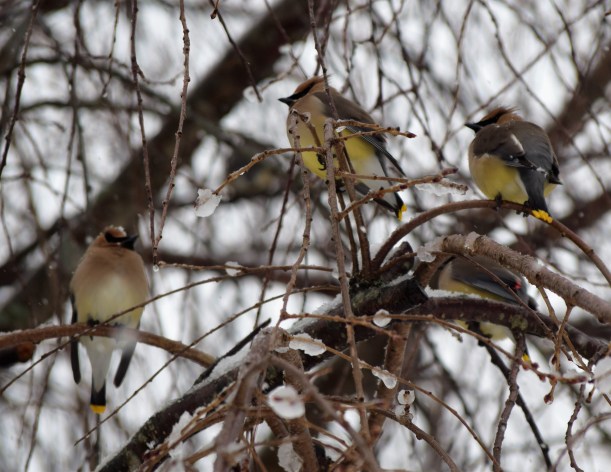
It snowed again in southern New Hampshire over the weekend – about five inches of slushy, heavy snow. The wintry early April day brought a flock of seven Cedar Waxwings to the garden. When they weren’t stripping the few remaining red berries from the holly shrubs, they were huddled in the Weeping Cherry tree.

DSC_0757

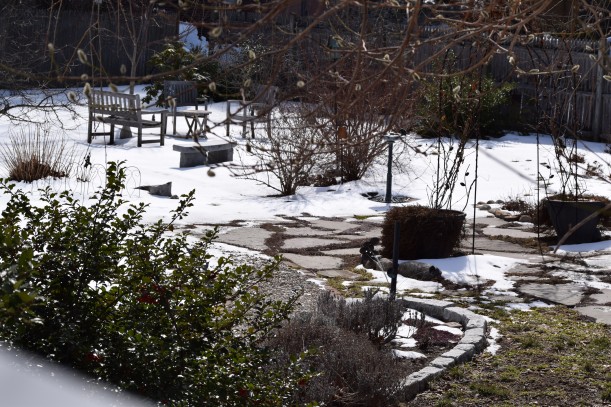
Today, it’s sunny and 60 degrees (F) at 4pm. The longer days of sunshine are quickly melting the latest – and hopefully last – blanket of snow.

DSC_0777.JPG

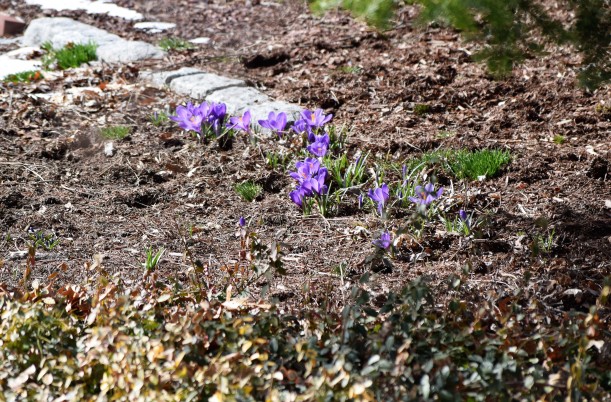
While most of the paths in the garden are still white and slippery,  a swath of purple blooms caught my eye when I stepped onto my my front porch to get the mail.

Spring has arrived! The crocus are blooming — just as expected in early April.

DSC_0776 (2)

I grabbed my camera and walked through the areas of the garden where sun melted the snow from the stone paths.  (The ground in these few areas is very soft, almost muddy, so I didn’t venture far.)

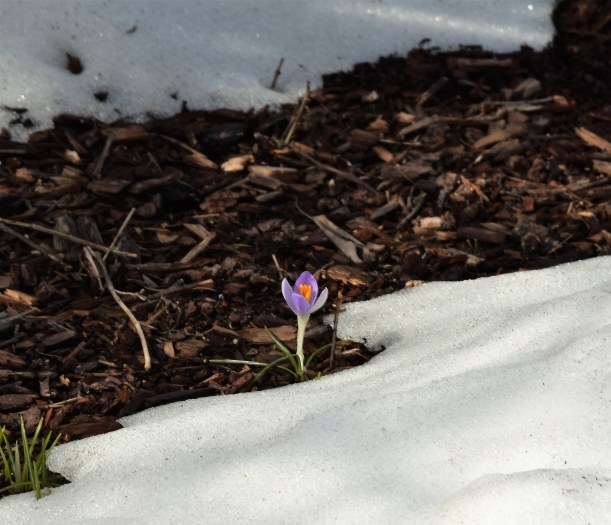
It’s always a thrill to find the crocus in bloom. While expected, it always feels like the first flowers are a miracle.

The garden still has a brown dormant winter appearance – from the decaying leaves, pine needles, and sticks that will eventually be picked up either by the birds building their spring nests or during the initial hours of our annual spring cleanup gardening day.

No matter how sleepy the garden appears under the latest blanket of snow, Mother Nature does a spectacular job of waking the flowers that typically appear in late March thru early April.  This includes the crocus and scilla.  As soon as the purple crocus start to wind down, the bright scilla open to full bloom to bring new life and spectacular streaks of blue to line the garden paths. I don’t even need a calendar to know when Easter is just two weeks away.  Seeing these two spring flowers in bloom is always the first indication that the Easter Bunny is expected very soon. (And that it’s time to pick up the ingredients to make the traditional Pickled Beet Eggs for the pending holiday.)

While walking through the garden this afternoon, my soul filled with gratitude. Not just the sights of pops of bright color hear and there, but with the sounds of the songbirds who are out, searching for their spring mates.

I felt caught between two seasons – winter because of the snow cover. And, spring with with the early blooming bulbs.  I’d once read a quote about crocus that included the word Grace. That seems like the perfect way to end today’s story.

DSC_0775 (2)

“A single crocus blossom ought to be enough to convince our heart that springtime, no matter how predictable, is somehow a gift, gratuitous, gratis, a grace.”

-David Steindl-Rast


1 Comment

Great Gardening Expectations

My Early Gardening Influences
Long before HGTV, the only Gardening program I remember on television was ‘The Victory Garden’ on PBS.
I learned so much in the 1990s from one of the show’s early hosts, Roger Swain. I always trusted his insight about growing vegetable gardens in New England. I also learned just as much from ‘Chef Marian’ (Morash), who shared recipes and tips on how to prepare and cook the vegetables featured during each program.


For over 20 years, Marian Morash’s ‘The Victory Garden Cookbook’ has been my ‘go-to’ guide for various ways to prepare fresh vegetables. It’s one of my all-time favorite cookbooks, originally published by Alfred A Knopf, Inc in 1982 and retailed for $39.95. It’s truly endured the test of time and continues to be worth the initial investment. (By the way, this book was republished in 2010 by Knopf Publishing and can be ordered for $37.95 from my friend Dan’s indie bookstore – Water Street Books – in Exeter, NH. Tell Dan I sent you!)

I also feel the need to mention other gardening influences – since I know my mom is a regular reader of this blog. She and my grandfather will always be noted as my earliest gardening mentors. It was always amazing to me that Mom had as much – if not more – knowledge as Roger Swain — she just didn’t have a TV show to validate her expertise 25+ years ago. Today, she is THE ‘go-to’ woman among our networks of friends to identify just about any plant or flower native to New England – as well as southern Florida. I’ve learned a lot from her, but still need to refer to guides to confirm some plant name suspicions.
Fast Forward to 2017
With a well-established garden, I still read magazines and books, as well as attend events like the annual Boston Flower Show, for new ideas and insight on gardening trends. Two topics have been of special interest to me over the past few years:
1) Saving seeds from year to year; and
2) Dealing with an invasion of weeds, without resorting to the use of harmful herbicides.
It was though the Nashua Public Library knew of my two special focus areas. In early January, I was delighted to read about an upcoming seminar about ‘Seeds and Weeds’ FEATURING Roger Swain! I didn’t think twice about signing up and requested two spaces, so I could bring Mom, too.
Nearly 100 Nashua area gardeners schlepped to the Nashua Public Library on a very cold February night for the free seminar. Honestly, it was such a treat to be out, talking with other like-minded people about the hope of spring and gardening in the middle of winter. The timing was perfect since by February 16 we were just starting to notice the days were growing noticeably longer — darkness had started to set in around 5:30pm instead of 4:30pm,
We arrived at the Library and Swain was already at the front of the room chatting with early arrivals. When the clock struck 7pm, Swain removed his sweater vest to reveal his trademark red suspenders and spent the next hour telling his stories about gardening in New England – with a special emphasis on better understanding weeds and how to control them.


The Truth about Weeds
The big take away for me (and for Mom, too!) included the need to use the right tools for weeding AND being out in the garden, early in the morning to remove newly emerging weeds – not late in the day as I tend to do. Just for the record, my mom always claimed there are thousands of very old seeds hiding deep within soil — everywhere. She’s always been against the spring ritual of rototilling. Her argument has been that the process of rototilling results in more weeds and in the end, more work. Of course, Swain confirmed her theory and once again she’s been right all of these years. Swain suggested long handled hoes that you sweep across the ground (while standing up) to gently pull up newly emerged weeds. Not one to complain about skipping the back-breaking kneeling that I associate with weeding, it looks like the 2017 budget for ‘Preen’ will be spent, instead, on some fancy new hoes this year!
I also appreciated Swain’s comments about organic gardening. He talked about “PMO Gardening” (Pretty Much Organic Gardening). I feel vindicated with this thought. Over the past decade, I’ve been especially careful of the seeds, plants, and the various soils and composts brought into the garden, especially for the things we eat. I have a compost tumbler, but the truth is, it takes a few years to get really good quality compost from this gadget I bought over 10 years ago. Honestly, it’s one of the most disappointing items I’ve ever purchased for the garden – but it’s here and we use. I like the idea of re-purposing things back into use – for example, I’ve started to shred leaves in the fall and use them as mulch in the garden beds vs. buying a hundred bags to have the leaves carried to the landfill (Nashua has a wonderful soft waste curbside collection service, but I’d prefer to let the leaves turn into mulch in my own yard). When I had the limestone steps replaced on my porch with granite, the mason was kind enough to cut the old limestone into squares to use as garden stepping stones, saving a trip to the landfill. So, from now on, I’ll always remember that as long as I try my best to be a good steward of nature, it’s acceptable to be a “PMO Gardener” and to even sometimes use an herbicide, but only when used sparingly and absolutely necessary. (Thanks for taking away all the guilt, Mr. Swain!)
Seeds Bring Great Expectations
Once Swain finished his stories, the event transitioned to a Community Seed Swap across the hall from the seminar. The event organizers encouraged gardeners to bring seeds to share with one another. I took this request seriously and was thrilled to prepare 70 packages for other local gardeners to take home.

I brought a variety of seeds from perennials and annuals in my own garden including: Zinnias that originally started in the Community Gardens at Greeley Park in Nashua a few years ago; Jewel-toned Morning Glories; Baptisia aka: False Indigo; and Rudbeckia Maxima.
It was a relaxing (and hopeful!) process in early February to separate the seeds and create the packages with photos and information from my own garden. I even felt well-rewarded when I left the Seed Swap part of the evening’s program. I brought home seeds donated for the event by the High-Mowing Seed Company. I look forward to planting them to grow mixed greens and herbs, as well as some interesting varieties of kale starting in mid-May.
While spring arrived on the calendar yesterday, the view of the garden from my office window today (where I write this blog) is telling me Mother Nature has not yet received the ‘2017 Change of Seasons Memo’. We still have a thick, crunchy blanket of snow from last week’s Stella Blizzard – but I do see improvement as the St. Francis statue (on the bottom left) was covered with snow up to just under his chin only a few days ago. I’m so glad to have these little packages of seeds to give me hope and ‘Great Expectations’ on a just another late March day.

“It was one of those March days when the sun shines hot and the wind blows cold: when it is summer in the light, and winter in the shade.”
~Charles Dickens, Great Expectations


3 Comments

The Power of Patchouli

Patchouli reminds me of Brussels Sprouts or Cilantro. You either love it – or hate it. There’s really no in-between.

Personally, I’ve always been fond of Patchouli, enjoying its fragrance in candles and essential oils. I knew Patchouli came from some exotic plant, but never in my wildest dreams thought about growing it in New Hampshire – until early spring of 2015.

While shopping for container annuals and herbs at Salem’s Lake Street Nursery during the early days of spring, there it was….a tiny 4 inch pot of Patchouli for under $5!

This trip to the nursery was after the record breaking winter of 2015, so there was so much hope for the months ahead – coming across the small Patchouli plant was an unplanned bonus. I had no idea what to do with it – nevertheless, it made its way back to Nashua  to be added as a whimsical item for the 2015 garden.

The young leaves had the fragrance of….well…Patchouli!

It was amazing to touch the leaves, releasing their oils to scent my hands and the air nearby.  It was also fun to show it to garden visitors, by breaking off a piece and asking them to guess what it is. Most people remarked it smelled familiar, but they can’t come up with the plant. Once I tell them, there’s always great discussion on the memories that the Patchouli fragrance evokes. One garden guest immediately shared that it smelled just like our friend, Karen. (She was absolutely right – I never think of Karen without thinking of her signature fragrance!)

By the end of the 2015 growing season, the Patchouli plant was about a foot and a half tall and wide and it seemed a shame to let the October frost claim it. So, an experiment ensued.

I cut the stems off and dried the leaves to create a small dish of Patchouli Potpourri. Within a few weeks, the fragrance from the dried leaves disappeared. After cutting back the plant to the soil level, it was watered well and over-wintered in the basement.  By spring of 2016, the Patchouli plant came back to life and was ready for another growing season in our New Hampshire garden.

dsc_0306

The perfect place in the 2016 garden was under a 30 year old Weeping Cherry tree in the backyard.  By the end of the summer, it turned into a huge shrub – reaching its maximum size of 3′ x 3′. Unfortunately, the growing season was not long enough to allow it to reveal the white flowers I’ve read about when researching Patchouli.

By late September, as the cooler nights started to set in, it was time to do something with the Patchouli. I really wanted to create some essential oil…..so I did.

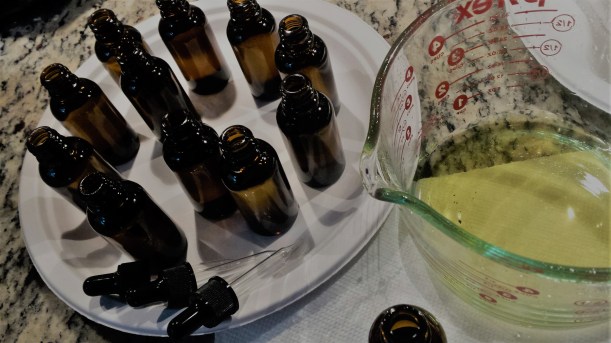
It was a several week process — I used instructions found online. Since I don’t have the equipment to steam distill the oil, I used the method of infusing the dried leaves in the oil. Basically, you dry the leaves and infused them in a carrier oil. I used organic Sweet Almond Oil.

patchouli-plant-1

Time to cut back the Patchouli

patchouli-cut-plant

The neighborhood Garden Cat supervised the Patchouli Harvest

patchouli-infused

Patchouli after being infused in oil for 2 months. The entire plant fit in one hand.

patchouli-bottling-step

Production line – 12 one ounce bottles!

The jury is still out on the final result.  Personally, the fragrance is light and smells fresh or green – not deep and musky as I expected. Apparently Patchouli Oil improves with time. As it ages, it turns darker and the fragrance grows more potent.

Interestingly, many people are anxious to receive gifts made with plants from my garden. Not true with the Patchouli Oil.  More people than not have kindly said, “Thanks but no thanks.” So my few Patchouli loving friends are part of a longer term experiment to determine if the end product actually improves as it ages – like a fine wine!

In the meantime, I’ve been researching the various uses for the oil beyond it’s powerful fragrance. Among other things, I learned Patchouli Oil has been used for thousands of years and was once considered very valuable, being used as an exchange for gold by early European traders.  One pound of Patchouli for one pound of gold. King Tut even arranged to have 10 gallons of it buried in his tomb!

The history also includes use to scent fabric in the 19th century, to keep moths away, as well as to treat skin maladies and sexual dysfunction.  Today, it’s being used primarily as I expected, as a fragrance. The aromatherapy benefits of Patchouli Oil include anxiety, stress, and depression relief. You can learn more about the history and uses of Patchouli Oil at Mercola’s website.

patchouli-bottled

In the end, my production of Patchouli Oil resulted in 12 ounces of medium-yellow colored oil – to perfectly fill the 12 bottles I ordered for the project.  The label designed for the bottles includes one of the sunflowers from my garden grown during the 2016 season.  It will be interesting to save a bottle or two for a few years to see if the fragrance and color deepen to what I was initially expecting.  Only time will tell.

“Suddenly, I felt like I was wearing Patchouli Oil in a room full of Chanel.”

~ Carrie Bradshaw, Sex and the City


Leave a comment

Find the Seed at the Bottom of Your Heart…

Gerber Daisies are one of my favorite flowers. Being an annual, there’s always a pot of them in the summer garden to add splashes of color among the perennials. That means I get to pick out a new plant each year – and there’s always a bright array of options ranging from red and orange to hot pink. My closest friends know that I can’t resist seeing one of these flowering plants or a bouquet of cut stems without taking a moment or two to absorb their beauty.

Gerbers are a plant that I can usually find at a local grocery store by mid February (Whole Foods in Nashua usually has great ones!) Bringing this live plant into my home during the later part of winter, as the days start to get noticeably longer, gets me excited for the start of the pending gardening season. (Especially on days like today, when the three storms over the past five days bring a fresh accumulation of over 25″ of snow.)

The ritual of adding this annual flower started about 15 years ago with a pot of bright red Gerber Daisies to welcome visitors at the entry to the backyard garden.  The blossoms were about 4-6 inches across were show-stopping as they bloomed all summer. There were always at least three flowers in bloom with as many buds pushing up through the dense soil. I diligently deadheaded the plant to always encourage new growth – until one day I faced a dilemma.

One of the newly emerged buds, on a stem still less than an inch tall, didn’t look like the others. It was very flat and lopsided, as if someone had tightly pinched it. Being close to the end of the growing season, there was only one more bud pushing through the soil. My first thought was to snip the odd bud. I didn’t.

About 10 days later, the most beautiful flower was revealed — a bright red Gerber Daisy with a beautiful, perfect heart center.

heartflower

I pull out this image every year, to share it with friends for Valentine’s Day. It’s a heartfelt reminder to look past perceived imperfections because there may be something perfect inside just waiting to be revealed.

Side Note: I think it’s important to share this factoid, since this is the ‘Garden with Grace’ blog. When Grace, the dog, was in a New Jersey shelter, her name was Gerber before she came to New Hampshire via an animal rescue group.  There were thoughts of adjusting her name to Daisy, keeping the thought of Gerber in place, but since she responded to Grace and arrived on Good Friday, the rest of history. That said, I think of that girl whenever I type the words Gerber Daisy. She had her imperfections too, including scars from years of abuse, but when cared for and loved, she had a perfect heart, too.

“Find the seed at the bottom of your heart and bring forth a flower.”

~ Shigenori Kameoka


1 Comment

Keep Your Face to the Sunshine…

There is always so much hope when seeds are planted  in late spring.

Especially sunflower seeds.

We look forward to their golden petals all summer, while at the same time, know that their arrival signals the transition to shorter days and the autumn season.

The New England weather challenged backyard gardeners all summer long as severe to extreme drought conditions gripped the region. (We lost our little bit of lawn — again — yes, that ‘Sad Sod Situation’ continues to be a challenge – but we’ll discuss that in another post someday.)

Beginning in  June, we watched the sunflowers struggle.  The dozen or so inch-high seedlings were a much sought after ‘garden buffet’ delicacy for this year’s over abundance of chipmunks and squirrels. In the end, we were able to grow a TWO eight foot tall sunflowers that became a stunning, late early autumn focal point, adding much-needed color to the garden. (Even the hydrangea failed to bloom due to the challenge of changing climate conditions.)

dsc_0395

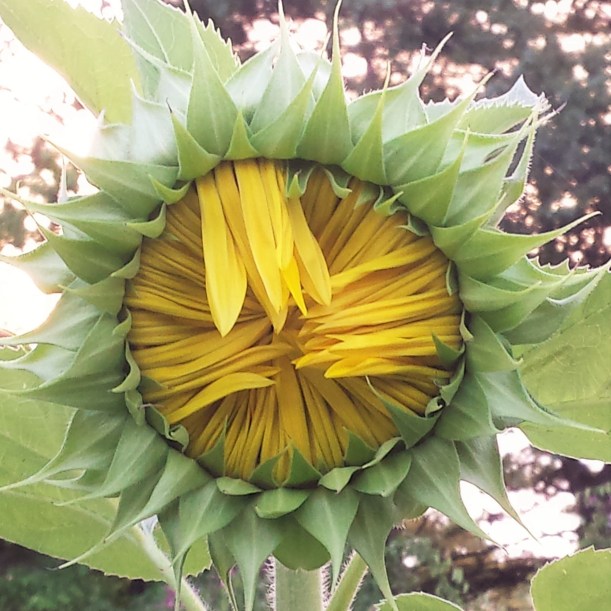
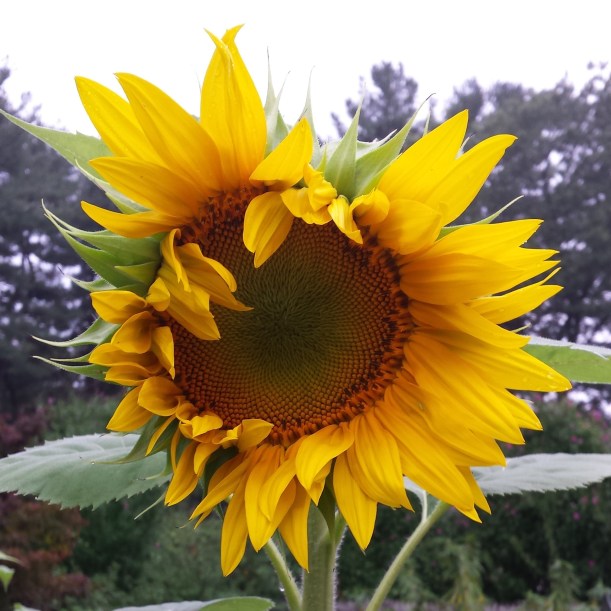
It was amazing to watch the single large flower on each stem slowly open and come to life over the course of four days.

20160907_171949.jpg

Day 1 – Ready to Burst

20160908_175742

Day 2 – Time to Wake Up

sunflower-almost-open

Day 3 – Almost There

sunflower-day-3-2

Day 4 – Hello Sunshine!

HELLO SUNSHINE!

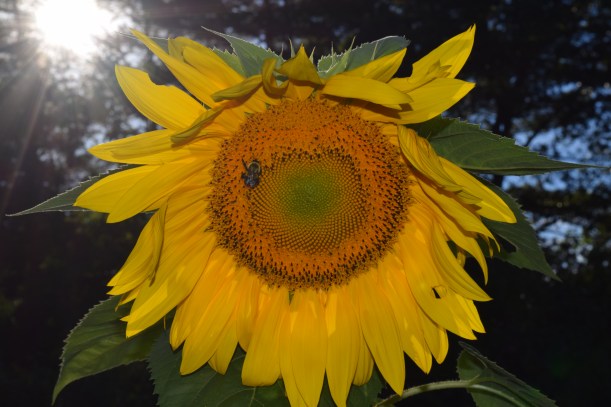
Once each flower opened, the bees quickly began their pollination process.  It was amazing to watch the bumble bees AND honey bees over the course of about 10 days navigate around and around the flowers’ centers to pollinate and bring the sunflower seeds to life.

dsc_0400

20160914_095852.jpg

As the seed head grew bigger and heavier each day, I was looking forward to harvesting some of the seeds to save for the 2017 garden. The plan was to leave the majority of the seeds for the songbirds to enjoy.

THEN THIS HAPPENED!

squirrel

20160923_121505

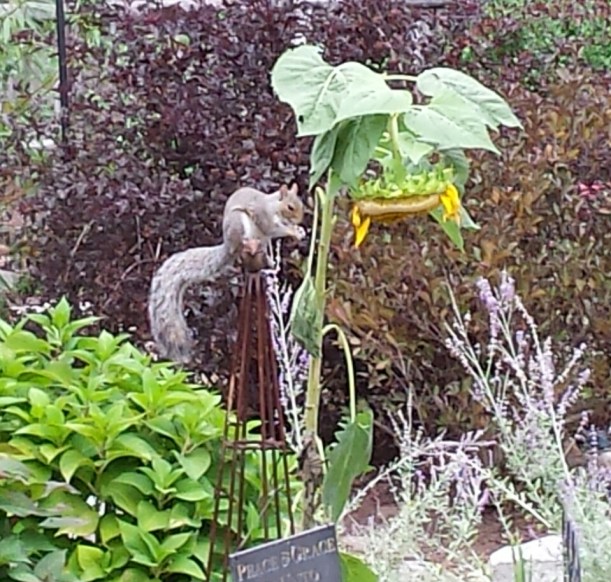
A squirrel used a nearby trellis as a ladder to reach the seeds.  Fresh sunflower seeds became another menu item in the backyard garden buffet. Delicious!

20160922_125048

20160922_173350

The seed head continued to swell for a few more days and approximately three weeks after the flower first began to show its sunny face, its head bowed deeply toward the earth as autumn set in.  By day 30, the squirrel came back, hungry and in full force, to strip the seeds row by row – creating an interesting pattern.

20160924_082226

Second to peonies, sunflowers have always been one of my favorite flowers (lavender would round out the top three.)  After enjoying hundreds of sunflowers from self-sown seeds in the Greeley Park Community Gardens a few years ago, it was gratifying to grow sunflowers in our own backyard garden this summer. Perhaps in 2017, we’ll double our crop …. and raise four of them!

This feeling of optimism that sunflowers bring must be part of the story behind the Helen Keller quote that inspired me to share the story of our 2016 sunflower success:

“Keep your face to the sunshine and you cannot see the shadows. 

 It’s what the sunflowers do.” ~Helen Keller


1 Comment

Gardening Epiphany

The post-gardening months of November and December were remarkable as 2015 came to a close.  It was unusally warm as autumn transitioned into winter.  And, for the first time that I can remember, the outdoor water spigots were still open on December 31st. (I just shut them off this week vs. the standard ritual of this happening by Thanksgiving weekend.)

Either Mother Nature was offering penance for last winter’s historic snowfall in New Hampshire, or she was just resting up for the coming New Year.

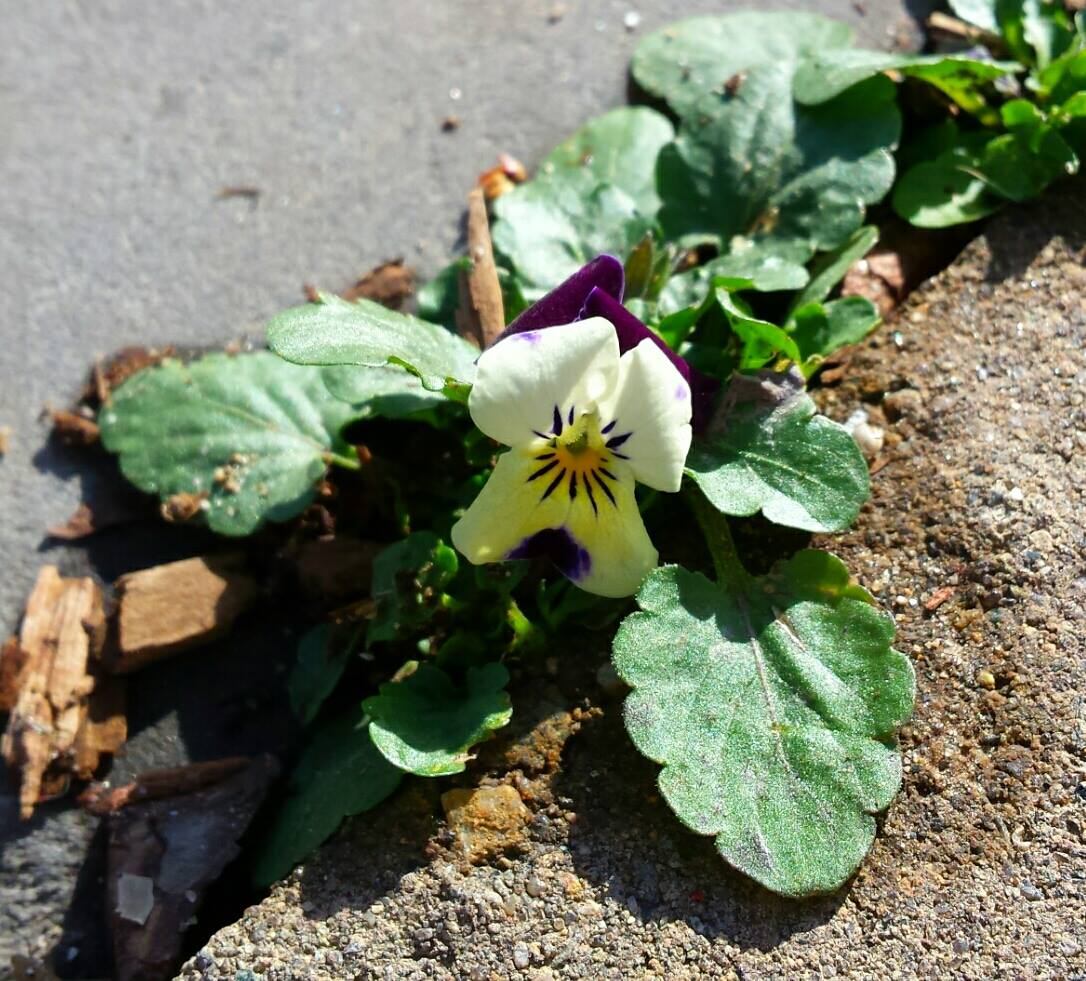
Most notable as the year ended, an amazing sight appeared on Christmas Day. Mother Nature offered the gift of a single viola (Johnny Jump Up) blossom in an area of the garden that is literally ‘between a rock and a hard place’. The honeysuckle on the back trellis pushed out a few orange-pink blooms, as well. It was a sunny, warm day on December 25th (the First Day of Christmas!) So warm in fact, the furnace was off for the day and the windows and doors had to be opened…..oh, and yes,  the flowers were blooming!

ChristmasPansy-2015

It was so different from Christmas Days past when it was almost impossible to go outside with temperatures in the single digits. But as always in New England, you just need to wait for a moment (or two) and everything changes.  Snow and ice finally arrived four days later and the garden is now under a soft white blanket to sleep for the next few weeks.

WinterBlanket

Don’t let a sleeping garden fool you.  Now is the most exciting time of the year for this garden blogger.  January is the month when I find that gardening activities are the most focused and important.

I browse the hundreds of photos that I’ve taken over the past season and make notes of what needs to be moved and removed. And this year, I’m adding the best photos from the season to my new Garden with Grace on Instagram page to complement this blog.

I flip through catalogues that still arrive by mail in January and February to see what is marked “NEW!” for 2016.

I read old gardening books and journals that are stored in my potting shed.  And this year, I’m reading a new book (a thoughtful Christmas gift from my friend Liz) that is a fascinating guide, called Wicked Plants: The Weed that Killed Lincoln’s Mother & Other Botanical Atrocities

I confer with my mother (my gardening mentor and co-gardener!) about plans for the coming spring. Our discussions over the past few years always involve the same three basic questions:

  1. Should we start some things from seed? (No. Not after that time in 2009 when we ended up with nearly 200 red solo cups of seedlings in our sun/garden room.)
  2. Will we order any special or “NEW!” plants to add to the landscape? (No. Let’s mark what we want from the catalogues and patronize local nurseries in the spring, instead.)
  3. What are we going to do with the two areas of grass that died again? (Don’t know yet. But the grass from my Sad Sod Situation story, just over a year ago needs attention again!)

These questions will no doubt be brought up in the coming weeks (usually during an evening ritual that my grandfather called ‘Coffee Break’. Others call it Cocktail Hour!) No matter the season or time of year, gardening is a 365 day obsession in my home.

So here it is, my 2016 Gardening Epiphany that arrived on January 6, the 12th Day of Christmas: You can take the Gardener of out of the Garden, but you can never take the Garden out of the Gardener.


1 Comment

Rediscovering Inspiration

It’s that time of year in New Hampshire. The garden is done…hit by multiple freezes over the past week. I spent this morning in the garage and potting room organizing tools, putting away hummingbird feeders, and just looking around to see what could be salvaged or recycled for 2016 and what will no longer make it through another gardening season.

The Garden Cat, who continues to stalk me, found that I was in the potting room at the back of the garage, so he joined me for a while…he settled into the perfect spot to look over the spent garden to keep an eye out for chipmunks.

20151025_112138After I finished my “chores” I took some time to browse through the “Garden Library” in the corner of the potting room. It’s an eclectic mix of gardening guides and books collected over several decades by multiple generations of family gardeners. Some are gifts from friends, as well. This special library is stored in old wood crates, including one from Producer’s Dairy in Nashua.

20151025_111717

Today, my eye was drawn to one of my all-time favorite books by Adelma Simmons. I met her in 1993 at her farm/garden that was known as Caprilands in Coventry, Connecticut.

20151025_111914

At that time, I had a fascination with herb gardening and my visit to Caprilands turned that fascination into what is now a lifetime obsession. She signed this book for me 22 years ago this month.

20151025_111934

A lot has changed since that visit to Connecticut. Ms. Simmons passed away in 1997 and her herbal paradise is no longer open to the public. You can read more about her via this link.

The one thing that is unchanged is my obsession of growing and using herbs for culinary, mixology, and aromatherapy purposes.

I loved rediscovering this gem of a book today and remembering back to the day that I visited Caprilands in October 1993. I look forward to reading “Gardens of Delight” again to find renewed inspiration for the 2016 garden. (Thank you Adelma! )


1 Comment

Beauty – Always in the Eye of the Beholder

At the end of a very rainy day, I felt the need to stroll through my now fading garden. After a few minutes, I was feeling a little down that the flowers, especially the mandevilla, are starting to shrivel and drop after a very dry summer season.

I heard a car pull up and stop on the other side of the hedge and could see a woman in the driver’s seat waving to me.

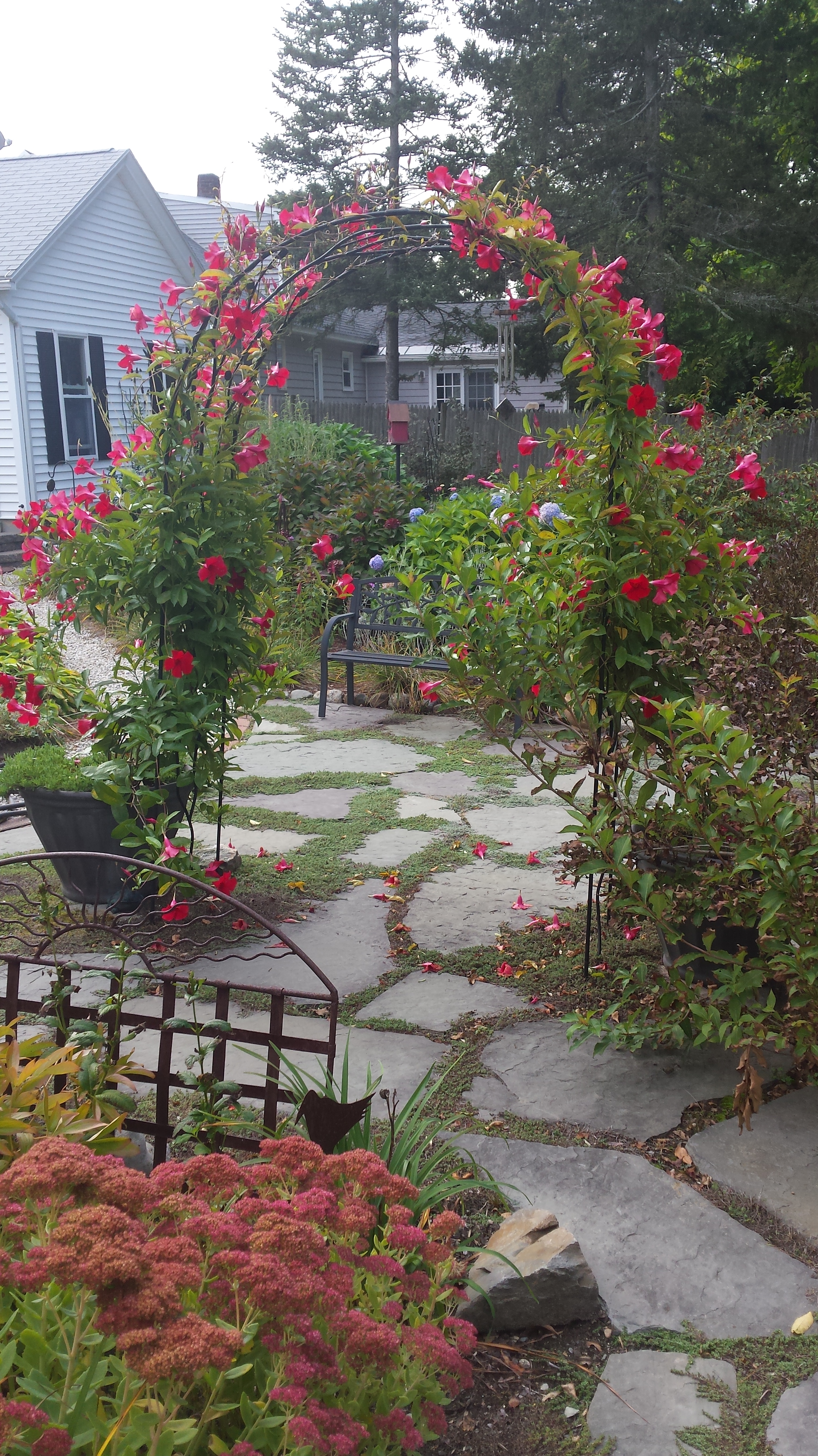
She rolled down the window and asked about the “beautiful red flowers” on the trellis. (The mandevilla that I was looking at as she pulled up.)

20151001_102154

The woman got out of her car and told me how she enjoys looking over the hedge and into my garden while she waits to pick up her daughter who visits nearby. (She enjoys listening to the wind chimes and watching the birds, too!)

We chatted for a few minutes about gardening and nature and peacefulness. It was an interaction that lasted only a few minutes.

The irony hit me. I felt sad about the exact same thing that brought her joy.

Before she left, we exchanged introductions. Her name is Grace.


Leave a comment

When the Garden Gives You Lemons, Make Lemon Drop Cocktails!

At the start of this year, I shared the story about the pink lemon tree acquired in October 2013.

We’ve waited for months for the first lemon to be ready to pick (almost a full year, actually), only to see hundreds of tiny lemons, barely the size of peas, fall to the ground during 3-4 growth cycles. While that may seem discouraging to some people, this plant has been enjoyed even without fruit for months, indoors and out.  Its tiny white and purple flowers are extremely fragrant, as is the beautiful, shiny, variegated foliage. When it isn’t indoors filling the garden room with lemon perfume, it’s outdoors bringing delight to the honeybees.

By late May, the pink lemon tree was moved from the garden room indoors to the back patio where it enjoyed outdoor living for 3 full months.  However, with the temperatures expected to drop into the 40’s (F) in New Hampshire tonight, it is time to bring this beauty indoors during the overnight hours

But, before that happens, we needed to pick a lemon. Today, the first lemon was harvested! The pink lemon variety never really turns completely yellow – it’s a creamy yellow color with green stripes. The fruit size is small, more like a lime or golf ball.

IMG_4913

A lot of thought went into what to do with this lemon – we really wanted to be able to taste its lemony flavor, but with only one lemon, there’d be hardly enough juice for even a thimble-full of lemonade.  The truth is that I didn’t care what the end offering would be, I just wanted to cut open the fruit to see its pink flesh.  It looked a little more salmon color than bright pink – and was beautiful.

IMG_4916

When you grow your own lemons, you enjoy fruit that is not covered in wax because it was shipped to your market from thousands of miles away.  Instead, the outside of the lemon rendered a big spray of oil when it was cut and then squeezed.

Thankfully, if you have vodka in the house, you can skip the lemonade and go right for a lemon cocktail.  I did a quick search online to find a recipe that only needed a few ingredients and Ina Garten offered the solution. Her recipe for a Lemon Drop cocktail was perfect – I simply cut the ingredient portions in half for my one, lonely lemon.

Voila! The most delicious Lemon Drop Cocktail that took nearly a year to make!

IMG_4917Cheers! And, here’s to the remaining 4 lemons that should be ready in as many weeks. If you have suggestions on how I should plan to use them, let me know via a comment!